What You Need to Know
Skin biological age is an indicator that characterizes the functional and structural condition of the skin, regardless of chronological (calendar) age.
Methods for assessing biological skin age are divided into molecular (epigenetic clocks), functional (elasticity, TEWL, hydration, Visia camera analysis), and phenotypic (wrinkles, pigmentation, texture).
Skin elasticity is considered one of the most practical non-invasive markers of biological age—it can be measured repeatedly, without a biopsy, on different areas of the skin, and over time.
Regular skincare and sun protection are associated with a slowing of the skin’s biological aging compared to chronological age.
Contents
1. Chronological and Biological Skin Age: What’s the Difference?
2. Which Skin Characteristics Change with Age?
3. What Factors Affect Biological Skin Age?
4. Methods for Determining Biological Skin Age—Current Research
5. Why Assess Biological Skin Age?
Conclusions
FAQ
Sources
1. Chronological and Biological Age of the Skin: What’s the Difference?
Chronological age is the number of years since the date of birth; biological age reflects the functional/molecular state of the tissue and provides an indication of the “physiological” level of aging, regardless of chronological age. In the context of the skin, this means that two people of the same chronological age may exhibit different degrees of structural and functional changes in the dermis and epidermis. [1]
The skin is the largest organ of the human body and, at the same time, one of the most accessible systems for assessment, in which aging processes can be observed not only visually but also evaluated using biophysical, molecular, and functional indicators. This is precisely why the concept of “skin age” is gradually shifting from a purely visual assessment to a quantitative characterization of its functional and molecular state. The complex interaction between signs of skin aging and systemic biological aging suggests that the physiological processes associated with skin aging influence systemic signs of aging and are, in turn, influenced by them. [2]
2. Which Skin Characteristics Change with Age?
Each person’s skin structure is unique: for some, external factors may play a dominant role, while for others, hormonal changes, immune dysregulation, or chronic inflammation may be the primary factors. Internal and external factors—which together form what is known as the skin exposome—influence the skin’s appearance and functional state. They affect all layers of the skin—the epidermis, dermis, and hypodermis—both individually and in combination. With age, DNA damage and epigenetic changes accumulate, and protein function becomes impaired. At the same time, stem cell activity decreases and mitochondrial function deteriorates, causing the skin to regenerate more slowly and respond less effectively to stress. Chronic low-grade inflammation and impaired intercellular communication further accelerate these processes. As a result, the skin loses elasticity, the epidermis thins, and wounds heal more slowly. External factors—primarily ultraviolet radiation, air pollution, smoking, and an unbalanced diet—exacerbate these changes [3]. Current scientific studies do not consider the internal and external factors of skin aging in isolation, but rather as an interconnected system that affects cellular homeostasis, the extracellular matrix, the skin’s barrier function, and skin regeneration (Fig. 4).
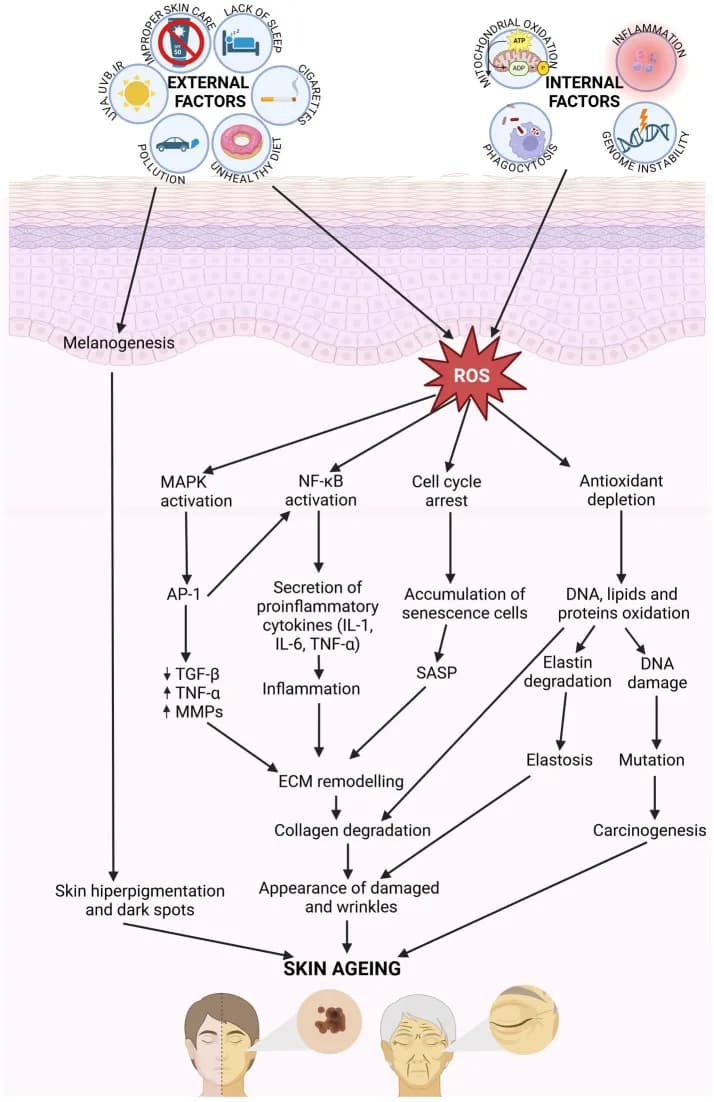
Fig. 4. Molecular mechanisms involved in skin aging. Internal and external factors generate reactive oxygen species (ROS), which activate specific biological signaling pathways (MAPK, NF-κB, and AP-1). This affects the remodeling of the extracellular matrix (ECM); collagen and elastic fibers break down, the skin becomes damaged, and wrinkles form. The combined effect of negative external and internal factors leads to the oxidation of DNA, lipids, and proteins, resulting in impaired cellular functions and skin aging. [4]
It is precisely this unique combination of factors that shapes an individual’s aging trajectory; therefore, even if two people have the same chronological age, the condition of their skin can differ significantly. In this sense, biological age can be viewed as a kind of “biological passport” for the skin. Thus, the biological age of the skin is an indicator that characterizes the skin’s current functional and structural state, regardless of chronological age. Gaining a better understanding of the process responsible for aging is one of the current challenges in aging research and biomedical research. In this context, the development of tools to assess the biological age of human skin and to analyze the key pathways associated with the aging process aims to improve interventions for skin rejuvenation and the maintenance of its long-term health. [5]
Biological age reflects the balance between the accumulation of damage—particularly due to inflammation, oxidative stress, and other processes—and the tissue’s capacity for recovery, repair, and regeneration. This balance is not determined by chronological age and is not directly visible: it can only be assessed using appropriate biophysical, functional, or molecular indicators. Importantly, skin age can be determined using several clinical measurements and may differ from chronological age, which determines the acceleration or deceleration of aging (Age A/D). In this context, the biological age of the skin is not an abstract concept but a potentially measurable characteristic of its condition. [6, 7]
3. What Factors Affect the Biological Age of the Skin
Different organs age at different rates — and this can be quantified
The results of clinical studies show that different organs and systems can exhibit different “biological” rates of aging in the same individual. This underscores the concept of “organ-specific” age indicators, which allows for the development of distinct biomarkers of aging for each organ. This approach makes it possible to detect, for example, accelerated aging of the liver, kidneys, or skin regardless of overall systemic (chronological) age. [8]
The skin is an important organ subject to both internal and external aging factors
The skin ages under the influence of internal factors (genetics, metabolic changes, hormones) and external factors (UV radiation, smoking, air pollution, diet). These factors significantly accelerate aging, which manifests as collagen breakdown, loss of elasticity, hyperpigmentation, and increased oxidative stress.
While chronological age is based on the year of birth, biological age describes the actual condition of the skin—and in the context of skin health, the age of skin cells. Depending on lifestyle, skincare, and genetics, this biological age can differ significantly from chronological age. Lifestyle factors such as diet, sun exposure, and the quality of skincare routines influence the skin’s condition. This creates the aforementioned “epigenetic pattern,” which is unique to each person’s skin and determines how “young” or “old” it is, regardless of chronological age. [9]
Skincare and sun protection change the “appearance” and signs of skin aging
Clinical and epidemiological studies have shown that regular daily skincare is associated with a slower rate of aging. Conversely, a lack of proper skincare and harmful habits (smoking, excessive sun exposure) are associated with accelerated skin aging. [10]
4. Methods for Determining the Biological Age of the Skin—Current Research
Epigenetic clocks adapted for the skin (skin-specific DNAm clocks, “skin & blood clock”) demonstrate a certain degree of accuracy in predicting tissue age based on DNA analysis patterns and are already being used as tools to assess the molecular age of the skin, albeit in experimental models. [11]
Current skin tests include elasticity measurements, which allow for an assessment of firmness. It is important to analyze the hydration of the stratum corneum, which reflects barrier function and hydration status. The transepidermal water loss (TEWL) test indicates barrier efficacy and any impairments. Additionally, sebum measurements are used to assess the condition of the sebaceous glands and susceptibility to acne or dry skin.
Tissue Characteristics of the Skin
Studies of the skin have shown that its biomechanical properties change with age—the skin becomes less “elastic,” stiffer, and its ability to return to its original shape after deformation decreases. The classic study “Age-dependent biomechanical properties of the skin” indicates that the modulus of elasticity, the skin’s ability to recover after stretching, its compliance, and other parameters change with age. [12]
Recent studies also demonstrate that such non-invasive methods—such as elasticity measurements—correlate well with age. In a clinical study, among most parameters, elasticity specifically showed a significant correlation with age. [13]
These parameters (elasticity, viscoelastic recovery) are non-invasive, repeatable, and relatively simple to measure in a clinical setting. Unlike a biopsy, they can be measured repeatedly, in different areas, and during dynamic monitoring (for example, before and after cosmetic procedures). Therefore, skin elasticity is currently considered one of the most practical indirect markers of the skin’s biological age.
Three Groups of Assessment Methods
Modern methods for assessing age-related skin changes can be broadly divided into molecular, functional, and phenotypic methods. Molecular methods—including epigenetic clocks, telomere length analysis, DNA damage, cellular aging, mitochondrial function, and inflammation—allow for the assessment of internal aging processes but often require tissue sampling. Functional and structural methods assess the condition of the skin barrier, TEWL, hydration, elasticity, the dermal-epidermal junction, and the extracellular matrix, while phenotypic methods assess wrinkles, pigmentation, texture, and other visible signs of aging. Since no single indicator fully reflects the biological age of the skin, the most informative approach is a comprehensive one that combines molecular, functional, and structural characteristics, allowing not only for the assessment of existing age-related changes but also for a more objective determination of the effectiveness of interventions aimed at maintaining skin health and longevity [14].
5. Why Assess the Biological Age of the Skin
Assessing biological age allows us to move beyond simply recording chronological age to characterizing an individual’s aging trajectory. Assessing biological age potentially allows us to:
more accurately evaluate the effects of procedures, regimens, and protocols;
detect signs of accelerated aging earlier, without waiting for pronounced clinical manifestations such as wrinkles, creases, or sagging;
make a preventive approach more evidence-based;
develop a long-term skincare strategy that takes into account the skin’s functional state and its regenerative capacity.
In this approach, biological age helps shift the focus from communication centered solely on outward appearance to an assessment of tissue quality and its functional reserve. For skin with established age-related changes, this means the ability to evaluate not only their visibility but also the condition of the underlying structures responsible for these changes.
Conclusions
Biological skin age is a measurable, not an abstract, characteristic: it integrates molecular, functional, and phenotypic data and indicates the extent to which the skin is “worn out” relative to its regenerative reserve, regardless of date of birth. This shifts the focus of skincare from visually correcting the signs of aging to addressing the actual functional state of the tissue — the barrier function, elasticity, hydration, and resistance to oxidative stress.
FAQ
How does the skin’s biological age differ from its chronological age?
Chronological age is the number of years since your date of birth. The biological age of the skin reflects its actual functional and structural condition—including hydration levels, elasticity, dermal density, pigmentation, and signs of photoaging—and can differ significantly from your chronological age.
What factors most influence the biological age of the skin?
There are two groups of factors: internal (genetics, hormones, chronic inflammation, mitochondrial function) and external (UV radiation, air pollution, smoking, diet, and skincare quality). Together, they form what is known as the skin’s exposome.
How is the biological age of the skin measured?
Three groups of methods are used: molecular (epigenetic clocks, DNA analysis), functional (elasticity, TEWL, hydration, Visia camera analysis), and phenotypic (visual assessment of wrinkles, pigmentation, and texture). A comprehensive approach is considered the most informative.
Why is skin elasticity considered one of the best markers of age?
Elasticity is a non-invasive and repeatable indicator: it can be measured multiple times, on different areas, and over time (for example, before and after procedures), unlike a biopsy or DNA methylation analysis.
Can skincare slow down the skin’s biological age?
Yes. Clinical and epidemiological studies show that regular daily skincare and sun protection are associated with a slower rate of skin aging, while the lack of these practices and unhealthy habits are linked to accelerated aging.
Why is it important to know your skin’s biological age?
It allows you to detect signs of accelerated aging earlier, more accurately assess the effectiveness of treatments and protocols, and develop a long-term skincare strategy that takes into account the skin’s actual functional reserve, rather than just its appearance.
Sources
Furman, D., Auwerx, J., Bulteau, AL. et al. Skin health and biological aging. Nat Aging 5, 1195–1206 (2025). https://doi.org/10.1038/s43587-025-00901-6
Wyles SP, Maredia HS, Ansaf RB, Dweydari MR, Hurt RT, Bonnes SL, Khosla S, LeBrasseur NK, Draelos ZD, Davis MDP. SkinspanTM: A Healthy Longevity Framework for Skin Aging. Mayo Clin Proc. 2025 Nov;100(11):1976-1991. doi: 10.1016/j.mayocp.2025.07.027. Epub 2025 Oct 1. PMID: 41032001; PMCID: PMC12702499.
Dorf N, Maciejczyk M. Skin senescence-from basic research to clinical practice. Front Med (Lausanne). 2024 Oct 18;11:1484345. doi: 10.3389/fmed.2024.1484345. PMID: 39493718; PMCID: PMC11527680.
Roig-Genoves JV, García-Giménez JL, Mena-Molla S. A miRNA-based epigenetic molecular clock for biological skin-age prediction. Arch Dermatol Res. 2024 Jun 1;316(6):326. doi: 10.1007/s00403-024-03129-3. PMID: 38822910; PMCID: PMC11144124.
Trojahn C, Dobos G, Lichterfeld A, Blume-Peytavi U, Kottner J. Characterizing facial skin ageing in humans: disentangling extrinsic from intrinsic biological phenomena. Biomed Res Int. 2015;2015:318586. doi: 10.1155/2015/318586. Epub 2015 Feb 12. PMID: 25767806; PMCID: PMC4341846.
Foucher, A., Nouveau, S., Piffaut, V. et al. Clinical vs. chronological skin age: exploring determinants and stratum corneum protein markers of differential skin ageing in 351 healthy women. Sci Rep 14, 23643 (2024). https://doi.org/10.1038/s41598-024-65083-4
Bay EY, Topal IO. Aging Skin and Anti-aging Strategies. Explor Res Hypothesis Med. 2023;8(3):269-279. doi: 10.14218/ERHM.2022.00030.